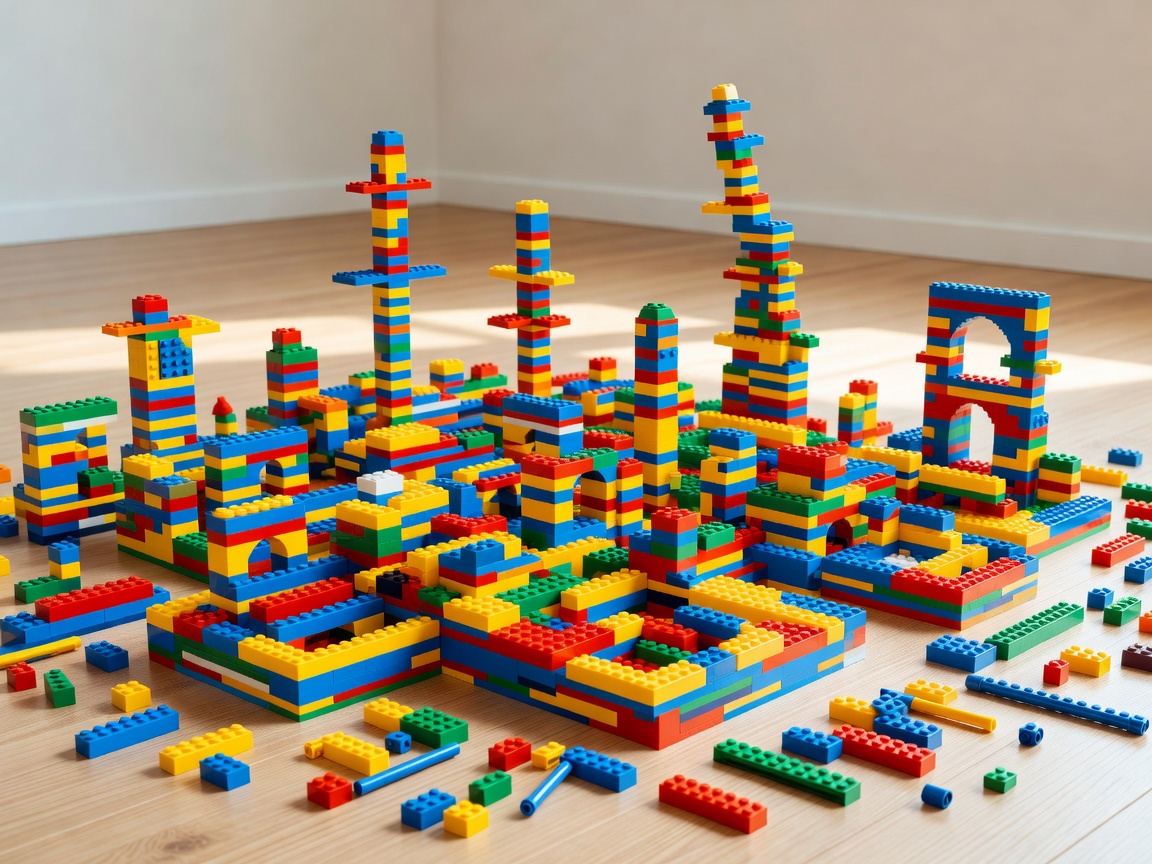
Create a challenge with room to think
A useful building prompt states the problem and leaves the solution open. “Build a bridge that can stand between two books” invites choices about span, support and shape. “Copy this bridge exactly” practises observation instead. Both activities have value, but they develop different behaviour.
Choose one main constraint. Limit the available shapes, require a moving feature, ask for a recognisable silhouette or define a fictional need. Too many restrictions turn exploration into compliance. If every material and step is fixed, builders spend less time deciding what to try.
Put the pieces where everyone can reach them. A broad mixed selection supports discovery. A smaller edited selection focuses attention on particular connections. Keep tiny or specialist elements appropriate to the builders and follow the age guidance and safety information supplied with LEGO products. Small parts require particular care around younger children.
Make forces visible through building
Brick structures provide immediate feedback. A narrow tower tips. Aligned seams split. A long unsupported span flexes. Builders can change one feature and see what happens without needing a formal calculation.
Ask direct questions after the first attempt. Where does the model move? Which joint separates first? What happens if the base becomes wider? Which pieces bridge the seam? The questions should direct attention, not reveal one approved answer.
Change one thing at a time
Keep the first model nearby, alter one structural choice and compare the result. The contrast makes the effect easier to discuss than rebuilding everything at once.
Failure is useful when the environment is safe and the task can be repeated. Do not celebrate collapse without reflection. Identify what failed, describe the change and try again. This connects playful experimentation with clear reasoning.
Use colour, symmetry and repetition
Repeated brick patterns make sequences tangible. Start a line with a simple colour or shape relationship and ask the builder to continue it. Then remove one element and ask what belongs in the gap. More complex patterns can combine colour, orientation and size.
Symmetry prompts work well on baseplates or along a clear centre line. Build one side and reflect it. Then break the symmetry deliberately and discuss how the result changes. Rotational patterns can be arranged around a central point, while repeating wall motifs introduce rhythm and spacing.
For sorting, ask builders to choose their own categories before offering standard ones. A piece might belong by colour, shape, connection type or imagined function. Explaining why a category works is often more revealing than matching a predetermined answer.
Turn models into story tools
A model can represent a setting, object, problem or character without needing realistic detail. Ask what happened immediately before the scene and what could happen next. Change one feature of the build and consider how the story changes. A missing bridge, closed gate or unusual vehicle creates a practical narrative problem.
Shared stories benefit from boundaries. Decide who may alter each part of the model and when. Builders can create separate locations, then connect them with roads, paths or a common event. The physical arrangement helps track relationships that may be difficult to hold in conversation alone.
| Prompt type | Focus | Example direction |
|---|---|---|
| Structural | Stability and connection | Span a gap with limited support |
| Pattern | Sequence and classification | Continue or repair a repeating design |
| Narrative | Cause, setting and communication | Build a place with a problem to solve |
| Mechanical | Movement and constraint | Create a feature that turns or lifts |
Share parts and decisions clearly
Group building needs more than a large pile of bricks. Give each person a meaningful role that can change during the activity: finding pieces, strengthening connections, checking the prompt, explaining the model or documenting changes. Avoid assigning all creative decisions to one builder and all sorting to another.
Agree how scarce pieces will be handled. A shared tray for hinges, wheels or special elements makes availability visible. If someone takes the final matching part, the group can adapt the design rather than discovering the shortage late.
- State the challenge in one clear sentence.
- Show the available pieces and any safety boundaries.
- Build a rough first attempt before discussing decoration.
- Pause and ask each builder to explain one choice.
- Identify one change worth testing.
- Compare the versions and keep the useful discovery.
End with a reset that includes everyone. Photographing the result can preserve the idea without preserving every model. Return pieces by broad category and leave the workspace ready. The cycle of building, explaining, adapting and clearing is more valuable than producing a perfect object.